


Why this report exists
Cybercrime has become one of the most common crimes in Australia, yet it remains one of the least understood and least reported. This report sets out to address that gap.
On the surface, the numbers look even: 27% of women and 26% of men report being victimised. But that parity hides something else. When cybercrime turns personal, through coercive control, stalking and image-based abuse, women carry the disproportionate weight of harm, and are far less likely to report it. Among victims of technology-facilitated abuse, 97.6% never reported to eSafety and 91.7% never went to police.
Drawing on a nationally representative survey of 2,003 Australians, this report from Women in Digital and Sekuro uncovers the gendered pattern behind the data, and why shame and fear are keeping the true scale of harm hidden.
Note: The data presented in this report was collected through a nationally representative online survey of Australian adults and complemented by qualitative interviews with subject matter experts. Together, these methods provided both measurable data on the scale and nature of cybercrime victimisation, and expert insight into the drivers of shame, fear and underreporting explored throughout this report.
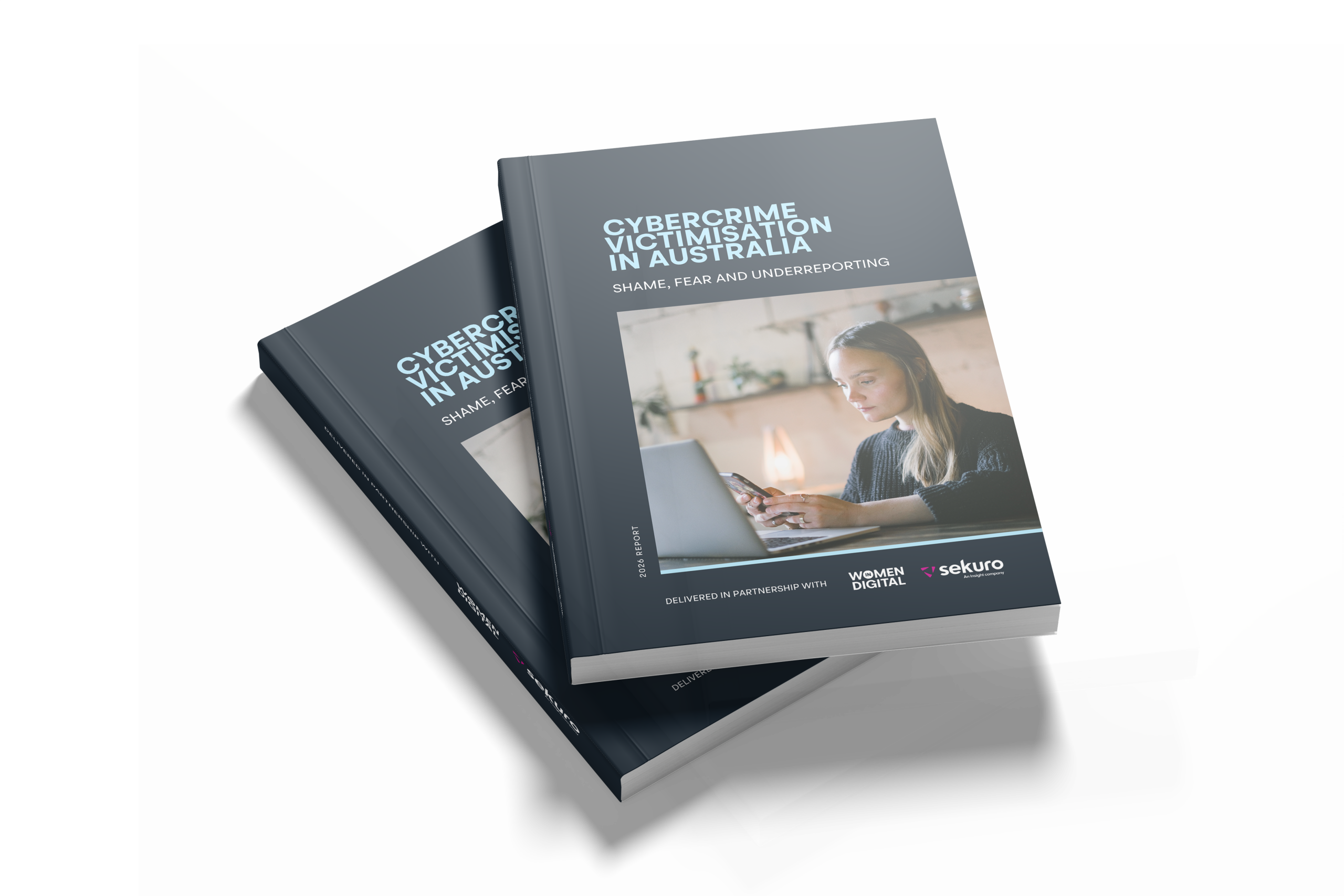
Download the Report
Get your free copy of Cybercrime Victimisation in Australia: Shame, Fear and Underreporting, a nationally representative study of 2,003 Australians developed in partnership with Sekuro.
Inside, you’ll find the real scale of cybercrime victimisation, the gendered pattern hiding behind the headline numbers, why victims stay silent, and six recommendations for closing the reporting gap.
By submitting this form, you agree that your details may be shared with our partner Sekuro, who may use them to contact you for marketing purposes related to this report.
What’s inside the report
The real scale of victimisation.
The pattern hidden behind the parity.
Why victims stay silent.
Expert voices from the sector.
Six recommendations for change.
What AI means for the threat ahead.
What the data tells us
At first glance, cybercrime in Australia looks like an even playing field. Men and women report almost identical victimisation rates, and the conversation stops there. But look closer, at who is targeted, how, and who stays silent afterwards, and a very different picture emerges. Here’s what 2,003 Australians told us.
The scale
27%
The parity that isn’t
63%
The silence
44%
Meet our Contributors

Charlize Liebrand

Leana El-Hourani

Adele Smith
This report was delivered in partnership with Sekuro, one of Australia’s leading cybersecurity firms, with deep expertise in digital risk, threat intelligence and organisational resilience. Together, Women in Digital and Sekuro believe that creating a safer digital environment for all Australians starts with understanding who is being harmed, how, and why current systems are failing them, and that this must take the gendered dimensions of cybercrime seriously.
“The technology sector has a particular responsibility here. That obligates us to do more than secure the perimeter, it means designing and deploying the tools we create with adequate safeguards in place, not just policies.”

Noel Allnutt, CEO, Sekuro