

Artificial Intelligence – Opportunity Brings Immense Responsibility
Artificial Intelligence – Opportunity Brings Immense Responsibility
There is no doubt we are working and living in a time of exponential change, where technological advancements are moving faster than ever before.
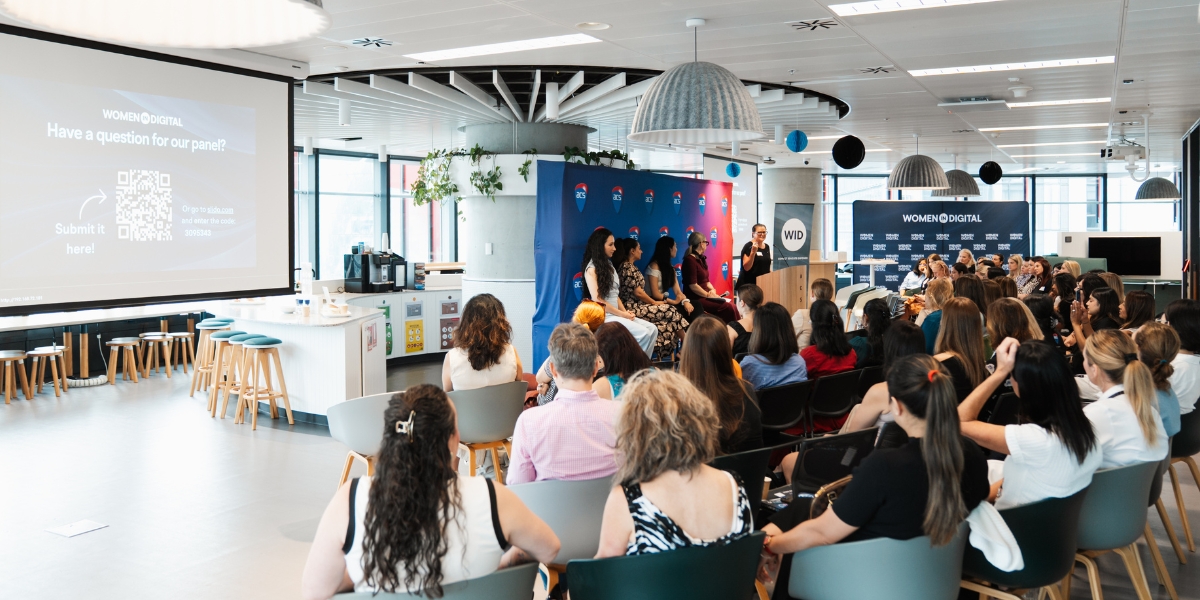
Whilst the crossroad of technology, leadership and generational forces is reshaping the modern workplace, AI is rapidly transforming how organisations operate with equity, representation, participation, belonging, and leadership evolving just as quickly. To add, at Women in Digital’s International Women’s Day events held in Brisbane, Sydney and Melbourne, it is evident these subjects are only gaining momentum.
Panel discussions featuring senior leaders across science, data, technology, cybersecurity and global industry reinforcing the future of work will be shaped as much by human connection and culture as by technological innovations and advancements.
The evidence overwhelmingly supporting current challenges and opportunities are not simply about adaptation, but navigating profound shifts in how people work, how career paths evolve and how opportunities are created and shared.
At Women in Digital, we strive to ensure that the conversations inspired by this year’s IWD events are not tokenistic and that accountable actions are implemented in organisations across Australia. Women in Digital has prepared articles summarising the key takeaways and trends important to women, our male allies and business leaders across the digital and tech sectors.
Artificial Intelligence Opportunity
It is widely believed that Artificial Intelligence (AI) is the defining shift of the next decade. AI represents a structural shift in how work is performed, how decisions are made and how value is created. AI will impact the size of workforces and their capability. Roles that centre on repetitive processes are more vulnerable and open to immense change. Some may evolve, many will disappear.
A key theme of our speakers this year highlighted that AI will only elevate the importance of human connection and capabilities and nothing will ever replace the enduring value of hard work, persistence and continuous learning.
The most effective strategy for navigating AI disruption is engaging and learning. Professionals who take the time to understand AI tools, experiment with them, and integrate them into their work will be better positioned than those who resist change. Many organisations are already investing heavily in workforce education – providing employees with access to AI tools and training programs that build familiarity and confidence.
These efforts serve a critical purpose: helping employees see AI not as a threat but as a tool for augmentation and productivity. In many cases, AI can eliminate repetitive tasks and allow professionals to focus on more creative, strategic, and human-centered work. In this new environment, the most valuable professionals will be those who combine technological literacy with human judgment with human connectivity.
As AI adoption accelerates, another issue becomes increasingly important: governance. AI systems can amplify existing biases if they are developed without diverse perspectives and ethical oversight. This makes representation within AI development teams especially important.If the individuals designing AI systems do not reflect the diversity of the societies they serve, those systems may inadvertently reproduce existing inequalities.
Strong governance frameworks, ethical oversight, and inclusive development practices are therefore essential. Organisations must treat AI not simply as a technology initiative but as a responsibility that requires careful stewardship.
Professionals who will thrive in an AI-driven world need to focus on developing the following skills:
Curiosity.
Individuals must take responsibility for understanding how AI tools work and how they can be applied. Continuous learning will become a professional necessity.
Critical Thinking.
AI systems generate outputs, but humans must assess their accuracy, relevance, and implications.
Creativity.
Original thinking, imagination, and the ability to see new possibilities remain uniquely human strengths.
Entrepreneurial Mindset.
Understanding how technology can solve real-world problems will create new opportunities for innovation and value creation.
Ethical Awareness.
As AI becomes embedded in decision-making systems, governance, transparency, and societal impact will become central leadership responsibilities.
Human Connectedness.
An AI-driven world will not be defined by the technology that surrounds us, but by our ability to use it to deepen empathy, strengthen relationships and preserve the human experience at the core of leadership and innovation within our professional and personal lives.
What Next?
The transition to an AI-driven future is not a passive event; it demands active participation and conscious leadership. The responsibility to harness AI as a force for good with one that promotes augmentation, productivity, and, crucially, equitable outcome, will rest with every individual and every organisation.
At Women in Digital, we hope that you allow the energy and insights from this International Women’s Day, serve you as a catalyst for action.
For business leaders, this means actively investing in governance frameworks, inclusive development teams, and comprehensive workforce education. For professionals, it means cultivating the essential human skills of curiosity, critical thinking, creativity and ethical awareness, the human traits that AI can never replace.