

The productivity bet on AI that we can’t afford to place without women over 55

The productivity bet on AI that we can’t afford to place without women over 55
Sally Browner, Fractional Director of Education at Women in Digital, shares her reflections.
I turned fifty this year, and the labour market has started to feel more personal than it used to. For most of my working life, “productivity growth” was a line in the business pages I skimmed straight past. It doesn’t feel abstract anymore. Some mornings it feels like the difference between staying useful at work for another fifteen years and quietly getting sidelined by a technology everyone insists is easy to pick up if you’d just try harder. Australia’s productivity growth has in fact been sliding for two decades now. The RBA’s Assistant Governor, Sarah Hunter, highlighted this using the graph below at the recent Australian Conference of Economists.1
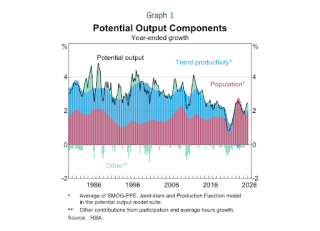
Potential output is built from three moving parts: population, trend productivity and other factors, and it is the productivity slice that has been shrinking. RBA (2026), Graph 1, original at rba.gov.au.
Sarah also said that artificial intelligence is one of the few forces with the potential to meaningfully lift productivity growth over the medium term.2 That’s encouraging, but a productivity dividend is realised only when the technology is taken up, competently and confidently, across the full breadth of the workforce. Unfortunately, the global evidence shows that women and older women in particular are not adopting AI at the same rate as men.
Deloitte research found women adopting generative AI at roughly half the rate of men in 2023, and still well behind a year later.3 A Harvard Business School study then established just how universal this is: synthesising 76 sources covering more than 300,000 people, it found women between 16 and 22 per cent less likely than men to use generative AI, a gap that held across almost every region, sector and occupation.4
The most important finding in that Harvard work, though, is what it rules out. The gap persisted even within the same occupation and employer.5 This is not a story about women being unable to get their hands on the technology. It is a story about confidence, trust and belonging, and that is precisely where age compounds gender.
The academic literature on digital learning is clear that self-efficacy (the belief people hold about their own capability) is mediated by both gender and age, and that this belief shapes how people engage with new technology at least as powerfully as their actual competence does.6 7 A woman in her late fifties who is entirely capable of using an AI tool may still hold back from it, because everything around her signals it was not built with her in mind.8 Evaluations of AI-development guidelines find that equity and inclusion are treated as afterthoughts rather than design requirements.9 Trust, which the University of Melbourne and KPMG’s global study identifies as a central brake on adoption, is hardest to earn from the over 55 age group,10 and Deloitte’s data shows women reporting materially lower trust than men that AI providers will protect their data.11
There is another, quieter barrier that anyone working in adult education recognises at once: time. Research on time poverty is unambiguous that women carry a disproportionate share of unpaid care, and it is that unpaid load, not any lack of interest, that most often consumes the hours in which learning would otherwise happen.12 For women in the second half of their careers, often supporting children and ageing parents at the same time, the margin is thinnest of all.
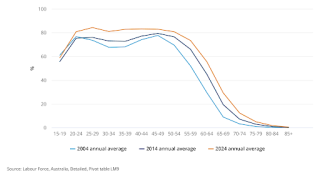
But why should anyone really care? Aren’t those women just on the verge of retirement? In fact, older women are one of the quiet success stories of the Australian labour market. On the ABS’s own figures shown in the graph below, the participation rate of women aged 55–59 has climbed from 52.1 per cent in 2004 to 73.5 per cent in 2024.13 These are experienced workers the economy is increasingly leaning on, which is exactly why stranding them on the wrong side of the AI divide would mean missing important productivity upside.
So how do we leverage the opportunity rather than putting people out to pasture? The Urban Institute’s recent brief on AI and older workers makes the case plainly: task augmentation and automation are arriving across every sector and every level of experience, and older adults can be prepared for them, provided training is designed deliberately for them, rather than assumed to trickle down from tools built for younger digital natives.14 And research into the gender-specific differences in how people perceive and understand AI finds that the interest in training is frequently already there.15 Willingness is not the missing ingredient. Design is.
The practical implications are not mysterious. Build AI capability into the flow of real work rather than bolting on a webinar. Design for the learner who is time-poor and starting from a lower base of digital confidence, not the enthusiast who needs no help. Treat older women’s professional judgement, the very caution that makes them wary of a tool that confidently invents things, as an asset to be harnessed, not a resistance to be managed. And measure success by confident, applied use across the whole workforce.
The Reserve Bank cannot manufacture our productivity growth with interest rates. AI might help manufacture it, but only if it reaches everyone doing the work. Whether it does is, for once, genuinely within our control. We should choose not to waste it. Turning fifty has made me impatient about a lot of things. This is one of them.
References
1. S. Hunter, “Understanding Supply Shocks and Their Implications for Monetary Policy,” address to the Australian Conference of Economists, Reserve Bank of Australia, 8 July 2026, rba.gov.au/speeches/2026/sp-ag-2026-07-08.html.
2. Hunter, “Understanding Supply Shocks and Their Implications for Monetary Policy,” address to the Australian Conference of Economists, Reserve Bank of Australia, 8 July 2026, rba.gov.au/speeches/2026/sp-ag-2026-07-08.html.
3. Hupfer, B. Matheson, G. Crossan, A. Bucaille and J. Loucks, “Women and Generative AI: The Adoption Gap Is Closing Fast, but a Trust Gap Persists,” Deloitte Insights, 19 November 2024, deloitte.com.
4. Cranney, S. Delecourt, and R. Koning, “Global Evidence on Gender Gaps and Generative AI Over Time,” Harvard Business School Working Paper, No. 25-023 (October 2024, revised May 2026).
5. Cranney, S. Delecourt, and R. Koning, “Global Evidence on Gender Gaps and Generative AI Over Time,” Harvard Business School Working Paper, No. 25-023 (October 2024, revised May 2026).
6. J.-C. Sakdavong and M. Peyrègne, “How Gender and Age Mediate the Effect of Self-Efficacy on Digital Learning Performance,” Communications in Computer and Information Science (in press).
7. T. Huu, “Impact of Employee Digital Competence on the Relationship between Digital Autonomy and Innovative Work Behavior: A Systematic Review,” Artificial Intelligence Review (2023), doi.org/10.1007/s10462-023-10492-6.
8. Hupfer, B. Matheson, G. Crossan, A. Bucaille and J. Loucks, “Women and Generative AI: The Adoption Gap Is Closing Fast, but a Trust Gap Persists,” Deloitte Insights, 19 November 2024, deloitte.com.
9. Cachat-Rosset and A. Klarsfeld, “Diversity, Equity, and Inclusion in Artificial Intelligence: An Evaluation of Guidelines,” Applied Artificial Intelligence 37, no. 1 (2023) DOI:10.1080/08839514.2023.2176618.
10. Gillespie et al., “Trust, Attitudes and Use of Artificial Intelligence: A Global Study 2025,” University of Melbourne and KPMG (2025), doi.org/10.26188/28822919.
11. Hupfer, B. Matheson, G. Crossan, A. Bucaille and J. Loucks, “Women and Generative AI: The Adoption Gap Is Closing Fast, but a Trust Gap Persists,” Deloitte Insights, 19 November 2024, deloitte.com.
12. Hyde et al., “Time Poverty: Obstacle to Women’s Human Rights, Health and Sustainable Development” (2020) DOI:10.7189/jogh.10.020313.
13. Australian Bureau of Statistics, “Spotlight: Changes in Participation Rates for Men and Women in Australia,” 20 March 2025 (Labour Force, Australia, Detailed; participation by age, Pivot table LM9), abs.gov.au/articles/spotlight-changes-participation-rates-men-and-women-australia.
14. Briggs and H. D’Elia, “AI and Older Workers,” Urban Institute, January 2026, urban.org/research/publication/ai-and-older-workers.
15. Armutat, M. Wattenberg and N. Mauritz, “Artificial Intelligence – Gender-Specific Differences in Perception, Understanding, and Training Interest,” Proceedings of the International Conference on Gender Research 7, no. 1 (2024): 36–43. DOI:10.34190/icgr.7.1.2163