

Trust Is Built in Drops and Lost in Buckets
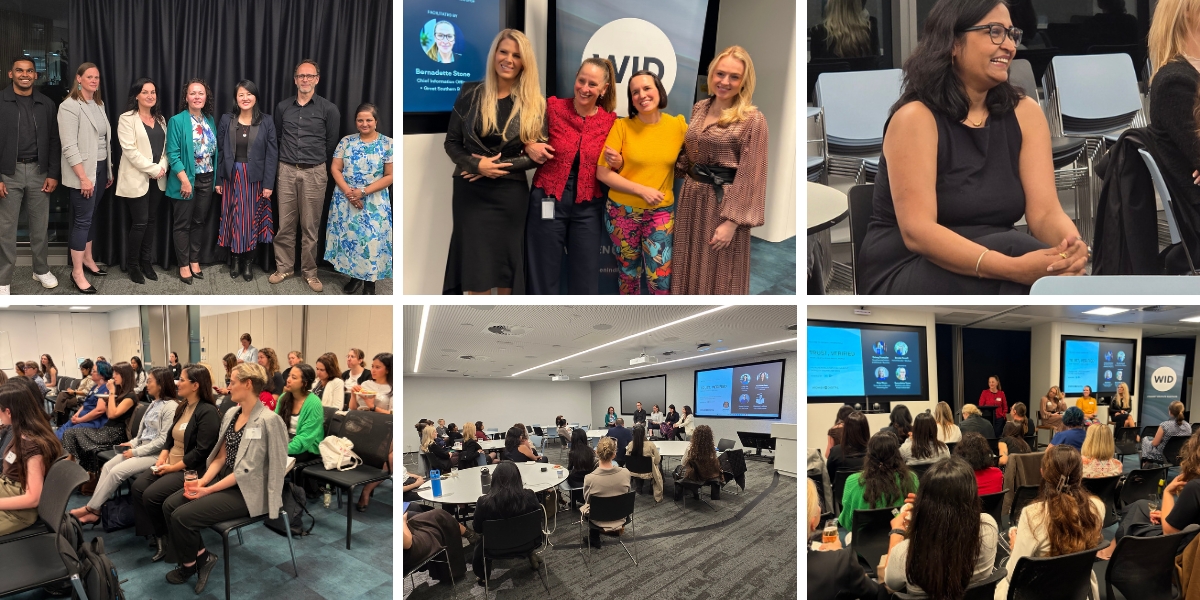
There’s an old saying that trust is built in drops and lost in buckets. It’s the line that opened a recent Women in Digital panel on trust, and it ended up capturing the thread running through not one but two separate WID conversations this month.
Our Brisbane event, hosted by Great Southern Bank, brought together leaders from banking, telecommunications and enterprise software. And in Melbourne, hosted by Microsoft, put cybersecurity, energy and small business leaders in the same room. Different industries, different cities, same uneasy question: in a world where AI can write our emails, clone our voices and answer our customers before a human ever sees the ticket, what does trust even mean anymore?
Across both nights, leaders from Great Southern Bank, Superloop, Salesforce, TechnologyOne, Microsoft, KPMG, Forestlyn, Shell Energy Australia and Cisco picked the question apart, and what emerged wasn’t a tidy answer so much as a shared discomfort. One statistic set the tone for both rooms: according to Deloitte’s latest human capital research, only 5% of organisations feel they’re making real progress on verified trust. The message from both panels, in the end, was less about the technology itself and more about honesty: what you tell your customers, your colleagues and your kids about what’s real, what’s AI, and what happens when it goes wrong.
Trust Is Built in Drops, and Lost in Buckets
Both rooms kept returning to the same basic mechanics of trust: it builds slowly, through consistency, transparency and reliability, and it breaks the moment a business’s actions don’t match what it says. There was a shared acknowledgement that most people now assume a chunk of their own personal data is already out there, given how many breaches have happened in recent years, so when deciding who to buy from or work for, people increasingly look past the marketing to the humans actually running the place, backed by instinct and what those around them are experiencing. Trust, in other words, is moving away from what a brand says about itself and toward whether the people behind it seem like they’d make the right call with your information.
Great Southern Bank’s own founding story fed into the same point. The bank was built on the idea of giving Australians a fair deal, including people traditional banking had overlooked, and nearly eighty years on, its branches and contact centre are still treated as core to the business rather than legacy costs to automate away.
The conversation at Microsoft broadened this further: we’re living through a general erosion of trust that has nothing to do with any one technology, whether that’s institutions, politics or the climate, and AI has simply put that erosion on steroids because change is now moving faster than most people feel they can control.
When AI Writes Our Words, Something Shifts
One of the sharper contrasts to come up all night: customers are increasingly comfortable chatting to AI support bots, some even personifying and thanking them by name, but the moment people suspect a piece of human-to-human communication was generated or assisted by AI, they tend to stop reading it altogether. A short, imperfect message written by a real person now reads as more sincere than a polished paragraph that’s clearly been run through a large language model.
There was broad agreement that these tools work best as an aid rather than a replacement, drafting and refining language rather than doing the thinking, and that it’s usually easy to spot when someone has used AI to do the bare minimum with no human voice layered back on top.
A harder truth surfaced too: most people accept an AI tool’s terms and conditions without reading the line that says their data, their code or their conversations will keep training the model. Trust, several agreed, is starting to blur, because convenience is winning out over actually knowing what’s been agreed to.
Where Trust Actually Gets Built: Governance, Not Guesswork
When the discussion turned to how leadership can help staff make good AI decisions without turning it into a compliance minefield, TechnologyOne’s approach came up: three principles it has built its whole AI adoption strategy around: create collaboratively, create empathically and create value.
Create value means asking, honestly, whether an AI application is actually worth doing rather than reaching for it because it’s there. Create collaboratively is about sharing what works and what doesn’t across the organisation quickly, through channels people already use, rather than building a new platform nobody opens. Create empathically brings the compliance team in early, running a fast risk self-assessment on any new idea before it goes anywhere near production.
Data sovereignty came up in the same breath. Organisations working with government, defence and universities are increasingly investing in local large language models built on an Australian AI stack, because so many mainstream models are trained in Europe or the US and don’t reflect Australian users, language or regulation with the accuracy those customers need.
Great Southern Bank described a similar philosophy from the infrastructure side: years spent front-loading data governance, mapping ownership, decision rights and lineage before it was needed, backed by a modern data platform. The argument was that governance done properly doesn’t slow anything down. It creates the certainty that lets a business move faster, because everyone already knows who can make which call, and what happens next.
The Bad Actors Have AI Too, So Do We
Nearly half of all malicious email activity today is phishing-related, and 90% of high-volume phishing campaigns now run on off-the-shelf kits anyone can buy. A recent survey found 77% of people can’t tell the difference between an AI-written email or image and a human-made one. Deepfake impersonation of public figures, from politicians to journalists, is increasingly being used as bait for crypto and romance scams, and one figure cited put the rise in deepfake-enabled fraud at roughly 3,000-fold over the past year.
The advice on offer was almost old-fashioned: know who a message is actually from, and remember that if something sounds too good to be true, it probably is. There’s a more modern angle too. The same AI tools scammers use can help ordinary people check a suspicious message just as fast, whether that’s asking an AI to translate an unfamiliar alert or checking whether a scam pattern has already been reported elsewhere.
Vigilance during an attack is only half the story. Rebuilding trust after a breach, both rooms agreed, comes down to honesty. Tell customers plainly what happened, what you’re doing about it and what they need to do next, and people forgive a mistake far more readily than they forgive being kept in the dark. What actually damages a brand long-term usually isn’t the breach itself. It’s finding out the extent of it, piece by piece, through a string of follow-up emails.
Future-Proofing Yourself When the Ground Keeps Moving
Both panel discussions closed on the same question: how do you future-proof a career when everything keeps shifting? The advice converged on a few themes.
- Take control of your own learning rather than waiting for an employer to hand it to you, and keep collecting varied experience, because it always finds a way to translate into whatever comes next.
- Stay curious across many sources at once, not just formal study, because building trust in your own judgement increasingly means learning to weigh information from several places rather than one.
- Know when to switch off, too. Reading, resting and disconnecting came up as often as any technical skill.
- And more than one conversation landed on the same blunt point: just start using the tools. Trying something you’ve never done before, even imperfectly, was described as the fastest way to build confidence in a fast-moving environment.
The other recurring theme was that the fundamentals haven’t actually changed.
- Understand your organisation’s greatest opportunities and your customers’ biggest frictions
- Stay curious about what employers are actually hiring for
- Have the confidence to ask directly what would make someone irreplaceable.
- Soft skills are becoming power skills. Communication, connection and adaptability were never soft. They’re what AI still can’t do.
Who Was in the Room
Brisbane
- Facilitated by: Bernadette Stone is Chief Information Officer at Great Southern Bank, where she leads the bank’s data and technology architecture strategy.
- Brooke Powell is an Account Executive at Salesforce and a State Ambassador for Women in Digital.
- Daisey Stampfer is Group Executive, Strategy & Transformation at Superloop, and a finalist in the AFR Women in Leadership Awards.
- Kate Shum is at TechnologyOne, working across conversational AI and student experience in the higher education sector.
Melbourne
- Faciliated by: Nicole Ballison is the Customer Delivery – Expert Care Leader at Cisco
- Vanessa Gage is Cybersecurity Director at Microsoft, leading the team that works with enterprise clients on AI security and governance.
- Lucy Lin represents small business perspectives across Australia and hosts the podcast Emerging Tech Unpacked.
- Shannon Lorimer is Chief Information Security Officer for KPMG Australia, Fiji and Papua New Guinea, and also covers Singapore, the Philippines and New Zealand.
- Simon Pearce is Chief Information Officer at Shell Energy Australia, having previously served as Chief Technology Officer at Origin Energy.
Both of these conversations were hosted as part of Women in Digital’s national events program, with Great Southern Bank and with Microsoft and Cisco. Want access to conversations like this? Learn more about WID membership.