

Why Most AI Projects Never Make It to Production (And a Simple Framework to Fix That)
Why Most AI Projects Never Make It to Production (And a Simple Framework to Fix That)
Tooba Jalalidil, AI Architect Manager at Accenture and Co-Founder of Seekario.ai, joined the Women in Digital community to share a practical, no-jargon approach to building AI business cases that actually get off the ground.
We’ve all seen it happen. A team gets excited about AI, runs a flashy proof of concept, presents a compelling demo, and then… nothing. The project quietly dies somewhere between “that looked amazing” and “so, who’s going to build this for real?”
It turns out, this isn’t a rare experience. Across the industry, industry estimates suggest most AI projects never make it to production. And the problem isn’t usually the technology. It’s the business case.
That’s exactly what Tooba Jalalidil unpacked in her Women in Digital masterclass, From Idea to Execution: How to Build and Lead AI Business Cases. Drawing on more than a decade of experience in AI, ML, and data strategy, plus her dual perspective as both an enterprise leader at Accenture and the co-founder of AI startup Seekario.ai, Tooba shared a rigorous, human-centred framework for evaluating which AI ideas are worth pursuing, and which ones deserve a hard pass.
Stop solving for “AI wishes.” Start solving for real pain.
Before you write a single user story or spin up a proof of concept, Tooba says there’s one critical step most teams skip: talking to the people who will actually use the tool.
Too often, AI projects start with an executive’s enthusiasm (“we need to do something with AI”) rather than a frontline team’s genuine frustration. The result? Solutions that look impressive on a slide deck but add work, instead of removing it.
Tooba’s advice is refreshingly practical. Shadow real users. Sit with them while they do their jobs. Ask one simple question: “If you had an AI teammate for six months, what would you ask it to take off your plate first?”
If you can’t write a one-sentence problem statement from the user’s perspective, tied to a specific role and a measurable pain point, you’re not ready to design a POC.
The DVFF framework: a pre-flight checklist for AI
The centrepiece of Tooba’s masterclass was the DVFF framework, a structured way to pressure-test any AI initiative before committing time, budget, and team energy. It stands for Desirability, Viability, Feasibility, and Finance, and it works like a pre-flight checklist.
Desirability: Does anyone actually want this?
This isn’t about whether 100 people could use it. It’s about how much time or pain it genuinely removes. An AI tool that saves 100 analysts 30 minutes a day is a very different proposition from one that saves 100 people 60 seconds a month. If the audience is small and the impact is marginal, the desirability score should be low, no matter how clever the technology is.
Viability: What happens if we don’t build it?
If the honest answer is “nothing material breaks,” you’re probably looking at a nice-to-have, not a strategic priority. Strong viability statements connect directly to revenue, risk, or customer outcomes. Think: “Without this, our new sales reps take nine months to ramp up, costing an estimated $1.2M in lost bookings annually.”
Feasibility: Do we actually have what we need?
This means getting honest about data quality, infrastructure, and team skills. A POC built on historical call transcripts will fall apart if half the real-world calls happen on mobile phones that aren’t recorded. And if your platform only supports nightly batch loads but the use case needs near real-time data, the cost and complexity may outweigh the value.
Team capability is often the hidden constraint. Tooba flagged a common pattern: capable engineers without deep data science or AI engineering experience push raw data into large language models, then compensate for noisy outputs by chaining more agents and prompts, driving up costs without achieving reliable results.
Finance: Can you explain this in dollars?
If you can’t translate the value into a language your finance team understands, your project is vulnerable. Vague promises of “productivity” invite hard questions about why existing tools (like Microsoft Copilot or standard automation) can’t do the same thing. Be specific: hours saved per role per month, reduced churn, higher conversion rates, and avoided infrastructure spend.
Turning scores into decisions
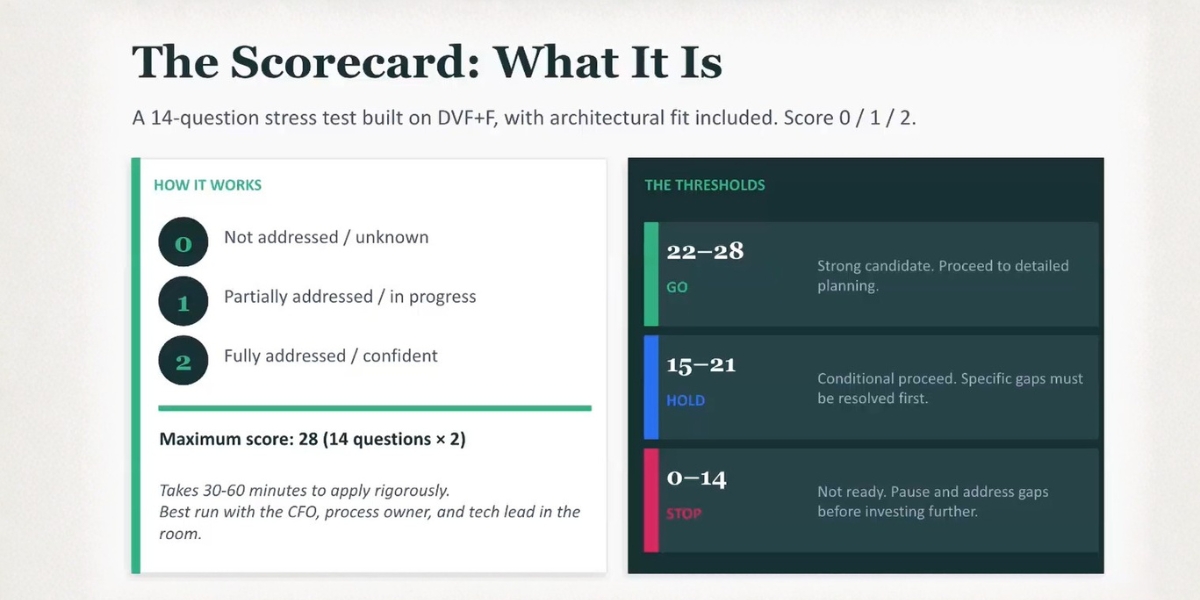
One of the most useful parts of Tooba’s session was her guidance on how to actually use the framework in practice. She recommends running a short scoring workshop where stakeholders independently rate each dimension before comparing results.
Define three to five questions under each DVFF pillar and score them from zero to two. Then look at the total, but also pay attention to weak spots. A project with strong desirability and feasibility, but a finance score near zero, is likely to be killed at funding review, no matter how exciting the demo looked.
Set clear thresholds in advance. For example, on a scale of zero to 24: a score below 13 means park it or re-scope; 13 to 18 means investigate further; 19 and above means you have a genuine candidate for a proof of concept.
The people piece matters most
Tooba closed with something that resonated deeply with our community: even the strongest DVFF score won’t save an AI initiative if you underinvest in adoption. Budget for training, documentation, internal champions, and support. In a world where most people now have experience with consumer-grade AI tools like ChatGPT and Claude, anything less intuitive will struggle to gain traction.
The real takeaway? Stop chasing shiny AI concepts. Back a smaller number of initiatives that are deeply tied to real problems, technically grounded, and financially defensible. That’s how you move from impressive demos to sustainable, live systems.
About Tooba Jalalidil
Tooba Jalalidil is a Manager at Accenture, where she leads the design and delivery of Generative AI solutions, and the Co-Founder of Seekario.ai, where she is democratising AI for job seekers. She combines enterprise rigour with startup agility, bringing over a decade of experience in AI, ML, and data strategy to drive responsible innovation. Tooba is also a passionate advocate for diversity in STEM and an active mentor, dedicated to empowering the next generation of leaders across the technology community.
This masterclass was hosted as part of the Women in Digital members’ webinar series. Want access to sessions like this? Learn more about WID membership.